
$124 Trillion Is Moving. Most Wealth Firms Are Not Where the Buyers Are.

The greatest generational transfer of wealth in history is underway. The generations inheriting it — Millennials and Gen Z — discover, research, and hire advisors in ways most RIAs and wealth enterprises are entirely unprepared for. Here's what the data says, and what to do about it.

By Ian J Karnell, CEO & Co-Founder, VastAdvisor — May 2026
We just published The $124 Trillion Wealth Transfer Is a Digital Marketing Problem — a research report that pulls together data from Cerulli, Bank of America, the Federal Reserve Bank of Philadelphia, PYMNTS, Capgemini, and a handful of other primary sources to look at where Millennial and Gen Z investors actually discover financial advisors, and where most wealth firms are showing up. The two are not the same place. That gap is the single largest unaddressed growth opportunity in wealth management right now.
This post is the executive read on the report. The numbers below are sourced directly from the full document. If you run growth, distribution, or marketing at a wealth firm, the punchline matters more than the page count.
The transfer is bigger than the industry has priced in

Cerulli's original 2021 projection of an $84 trillion intergenerational wealth transfer has been revised — sharply — upward. The June 2025 update puts the total at $124 trillion over the next 25 years, with the majority moving to Millennials and Gen Z. That is a 48% increase from the figure most of the industry is still planning around.
The breakdown matters more than the headline:
$46 trillion is projected to transfer specifically to Millennials (born 1981–1996). They already hold more wealth than any prior generation did at their age, and 55% expect to inherit by 2045.
Gen Z's earned income alone is projected to reach $36 trillion by 2030 and $74 trillion by 2040 — independent of inheritance. By 2035, Bank of America projects Gen Z to be the wealthiest and largest generation in the U.S. economy.
72% of Americans report they do not feel confident in their ability to manage a financial windfall of this scale. The demand for trusted advice is structurally there. The question is who they find when they go looking.
That last point is where the strategic problem lives. The transfer is not a future event. Millennials are in peak earning years and actively choosing advisors right now. Gen Z is entering the asset-accumulation phase with digital-native expectations that the previous generation never had.
The buyers are already digital. Most firms are not.
The behavioral data on next-generation investors is consistent across every primary source we reviewed. They start digital. They evaluate digital. They convert digital.
A few numbers from the report:
42% of Americans ages 18–29 report getting financial advice from social media — compared to only 27% who use a financial advisor or planner for guidance (Federal Reserve Bank of Philadelphia).
79% of Millennial and Gen Z consumers have been steered toward financial education by social media algorithms — not by outbound advisor marketing (PYMNTS, 2024).
39% of Gen Z and Millennial respondents use AI tools to budget or inform financial decisions; 27% use AI to run financial scenarios like homebuying (PLANADVISER / Citizens Bank).
73% of Millennials regularly communicate with financial advisors through digital channels, and 69% prefer email or video meetings over in-person visits (Wealth Solutions Report, 2025).
72% of younger investors rank trust as the #1 factor in advisor selection — above investment performance, fees, or firm prestige. Trust is built digitally, through content and presence.
Meanwhile, on the supply side:
Only 35% of advisory firms use digital advertising as a growth channel.
12% don't use social media at all.
The remainder lean on referrals, conferences, and centers-of-influence — the playbook of the previous generation (Paladin Digital Marketing).
The mismatch is the entire story. The largest generational pool of investable assets in history is researching advisors on platforms most wealth firms have not built a serious presence on. The firms investing now are not competing with the broader market. They are competing against a much smaller subset of early movers, on surfaces where buyer intent is already concentrated.
Where the next generation actually looks for an advisor

The report goes deep on platform-level discovery behavior. The summary, from the Federal Reserve Bank of Philadelphia data on Americans who use social media for financial advice:
YouTube: 66% — the dominant channel for financial education across both generations, and the platform 93% of U.S. teens already use.
Facebook: 55% — still significant, particularly among older Millennials.
Instagram: 44% — visual-first, brand-led, increasingly important for Gen Z.
TikTok ("FinTok"): 36% — accelerating, with high engagement on shorter-form explanatory content.
X / Twitter: 21%
LinkedIn: 18% — surprisingly low for financial discovery despite high firm presence there.
LinkedIn deserves a footnote. It is the channel where the wealth industry has invested most, and it is also the channel with the lowest pull among Millennial and Gen Z investors specifically seeking financial advice. That's not an argument to abandon LinkedIn — it remains valuable for B2B distribution and recruiting. It is an argument that LinkedIn alone is insufficient as a digital strategy for capturing inherited assets.
The implication for channel mix is direct: any firm whose digital footprint is concentrated in industry publications and LinkedIn is, by definition, not visible where the next generation is researching.
The other half of the gap: trust and credibility
The discovery problem is half of it. The other half is what happens after discovery.
83% of Gen Z report encountering misleading financial information on social media (Lewitas Hyman / PYMNTS). The credibility ceiling on the platforms where they research is low — which is precisely where credentialed, compliance-embedded firms can win share.
87% of Millennials say their family's existing advisor relationship was a key factor in deciding whether to continue working with that advisor (SmartAsset). Referrals still matter — but digital presence is what seals the decision after the referral lands.
72% of high-net-worth individuals now expect personalized products and services from their wealth management providers (Capgemini). Personalization is table stakes, not a differentiator.
Taken together: there is a structural opening for a wealth firm that shows up on the right platforms, with credentialed content, embedded compliance, and personalization at scale. The current state of the market makes that a remarkably low bar to clear — most firms aren't trying yet.
Paid media is the lever, not the cost
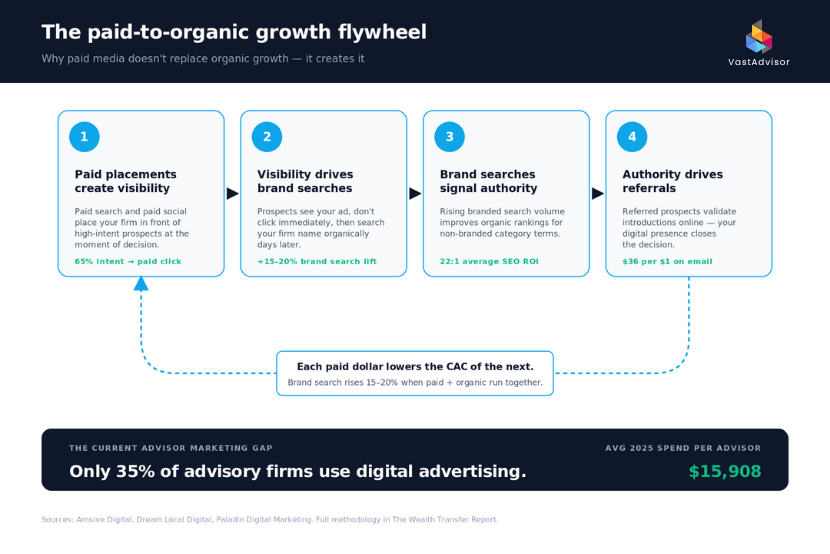
The most persistent misconception in advisor marketing is that paid advertising and organic growth are in tension. The report makes the opposite case, with the data to support it. Paid media creates a compounding halo — it lifts brand search, accelerates organic rankings, and increases referral conversion.
The mechanism is well-documented:
Paid placements create visibility in front of high-intent prospects.
Visibility drives brand searches — prospects see your ad, don't click immediately, then search your firm name organically days later. Brand search volume rises 15–20% when paid and organic run together (Amsive / Dream Local Digital).
Brand searches signal authority to Google's ranking algorithm, improving organic positions for non-branded category terms.
Authority accelerates referrals — referred prospects validate the introduction online, and your digital presence closes the decision.
The ROI math supports it:
$36 return per $1 spent on email marketing — the highest-ROI channel in financial services.
22:1 average SEO ROI — a $5,000/month investment generating $110,000/month in organic-driven revenue by month 12.
65% of high-intent financial advisory searches end in a click on a paid ad — paid captures demand at the exact moment of decision (Paladin Digital Marketing).
Average advisory firm marketing spend in 2025: $15,908 per advisor, up materially from prior years.
For a firm targeting clients with $750K+ in investable assets, $1,200 for a qualified discovery call is a strong ROI relative to a typical AUM fee structure. The math on paid media is not a cost conversation. It's a compounding-asset conversation. Every dollar of paid spend, properly architected, makes the next dollar of organic and referral cheaper.
What to do in the next 90 days
The report closes with three priorities. They are not sequential — they are concurrent, and each amplifies the others.
Build digital authority. Establish presence on the platforms where next-generation clients discover advisors — YouTube, Instagram, Facebook, and increasingly TikTok. Credentialed, compliant content creates the trust that converts. This is the foundation everything else compounds on.
Activate paid media. Paid search and paid social capture high-intent prospects at the moment of decision, and create the brand-visibility halo that drives organic and referral growth simultaneously. Underinvesting here is not a savings strategy. It is a share-loss strategy.
Govern AI adoption. 39% of next-generation clients already use AI in financial decision-making. Firms that deploy AI within a governed, compliant framework will meet clients where they are — without regulatory exposure. The firms that don't will either fall behind on customer experience or take on liability they haven't sized.
The order doesn't matter. Starting matters.
The full thesis
The 1,500-word version above is the exec read. The full report contains the methodology, the source-by-source breakdown, the channel-level data, the paid → organic flywheel diagram, and the strategic implications laid out for RIAs, wealth enterprises, and asset managers separately.
If you run a wealth platform, the report is worth the 20 minutes.
FAQ
How much wealth is moving in the great wealth transfer? Cerulli Associates' June 2025 update places the U.S. intergenerational wealth transfer at approximately $124 trillion over the next 25 years, up from the original $84 trillion projection in 2021. $46 trillion is projected to transfer specifically to Millennials. Gen Z's earned income is projected to reach $36 trillion by 2030 and $74 trillion by 2040, independent of inheritance.
Where do Millennial and Gen Z investors actually look for advisors? According to the Federal Reserve Bank of Philadelphia, among Americans who use social media for financial advice: YouTube (66%), Facebook (55%), Instagram (44%), TikTok (36%), X/Twitter (21%), LinkedIn (18%). 42% of Americans ages 18–29 get financial advice from social media — compared to 27% who use a financial advisor for guidance.
Why aren't most wealth firms showing up where the buyers are? Only 35% of advisory firms use digital advertising as a growth channel. 12% don't use social media at all. Most rely on referrals, conferences, and centers-of-influence. The result is structural: the largest pool of investable assets in history is researching advisors on platforms most wealth firms have not built a serious presence on.
Does paid media really compound into organic growth? Yes. Brand search volume rises 15–20% when paid and organic run together. Rising brand searches feed Google's ranking algorithm, improving organic positions for non-branded terms. Average SEO ROI in financial services runs roughly 22:1 at the 12-month mark. Email ROI runs roughly $36 per $1 spent. 65% of high-intent financial advisory searches end in a click on a paid ad.
What is a reasonable customer acquisition cost for a wealth firm targeting next-generation clients? Average advisory firm marketing spend in 2025 is approximately $15,908 per advisor. For firms acquiring clients with $750K+ in investable assets, $1,200 per qualified discovery call is a strong ROI relative to a typical AUM fee structure. The math on paid media is a compounding-asset conversation, not a cost conversation.
Ian J Karnell is the CEO and Co-Founder of VastAdvisor, the AI-native growth infrastructure platform for wealth management. Read the full Wealth Transfer Report.


Comments