
Signals

Ritholtz Wealth Management started in 2013 with $60 million in assets. Today it oversees more than $7.6 billion, and much of that growth traces to one habit: saying something useful the moment the market gave people a reason to listen. The firm was built on media as much as management. Barry Ritholtz's The Big Picture and Josh Brown's The Compound reacted to whatever the market was doing in real time, often while the story was still unfolding, and turned a Fed decision or a selloff into a point of view people actually wanted to read. As InvestmentNews put it, that content "drew a loyal following and turned many readers and viewers into actual clients," and "many clients began as fans of its blogs, columns, and podcasts." The commentary was the funnel, and every timely post compounded into client acquisition for a decade.
When the event is big enough, that same dynamic compresses into a single week. In March 2023, Silicon Valley Bank collapsed over a weekend, the largest U.S. bank failure since 2008, and by Monday billions of dollars were in motion. The firms that moved fastest had one of their best client-acquisition runs in years: as regional banks bled more than $100 billion in deposits, the largest banks took in over $120 billion, Bank of America alone pulling in $15 billion in a matter of days. JPMorgan sped up account-opening so a rattled business could switch banks and still make payroll that Friday, turning a market event into an onboarding funnel while it was still the headline.
The event creates the attention; the timely response captures it. But almost nobody has a Josh Brown or a JPMorgan onboarding desk. For most firms the window closes before they can act, less because they don't know a rate cut matters than because of the distance between event and action: someone has to notice it, decide who it's relevant to, write the message, clear compliance, and push it live before the clock runs out. So most firms give up on timing and run evergreen copy that lands on no particular day at all.
With v1.20, VastAdvisor's Signals closes the distance between a market event and a campaign that rides it, generated automatically and scored to the clients you actually serve.
So What Actually Is a Signal?
A signal is a market event the platform has decided is relevant enough for you to act on.
The financial world throws off thousands of events a day: rate decisions, inflation prints, jobs reports, GDP revisions, yield-curve moves, regulatory changes, sentiment shifts, regional business news. A raw feed of all of it is just a firehose, noise you have to drink. A Signal is the opposite of that: a single event the platform has already filtered against your practice, scored against your audiences, and explained in the language of your clients. When a rate cut surfaces as a Signal, it comes with the context that matters: why it affects your pre-retiree book, and a campaign already written to ride it.
Put simply: Signals watches the market for you. It continuously pulls from government data feeds, news, and economic releases, and when something happens that matters to your firm and your ICPs, you see it in real time and can act on it. Marketing that rides a current event beats evergreen copy by a wide margin, because relevance is what earns attention.

Why This Matters More Than Most Firms Realize
Timing is leverage in client acquisition, and there's now a decade of data that says so. Google's own research put it bluntly: demographics are dead, and this is the age of intent. Campaigns built around a prospect being at the right moment, not just the right demographic, deliver 20% higher ad recall lift and 50% higher brand awareness lift than demographic targeting alone. The message didn't get better. The timing did.
Reaction time. The value of a market-timed message decays fast. A rate-cut campaign launched the day of the decision is a conversation. Launched ten days later, it's old news: the prospect has already processed it and moved on. Manual workflows guarantee that latency, and Signals removes it.
Relevance. Google, LinkedIn, and Meta score how relevant your message is to the audience you're targeting, and they charge you for the gap. Google is explicit that a higher Quality Score lowers your cost-per-click and improves ad position, and WordStream's analysis of more than 15,000 accounts put a number on it: every one-point gain in Quality Score cut cost-per-action by roughly 22%. Meta and LinkedIn run the same play, rewarding relevant ads with lower costs and better placement. Timely, relevant messaging is simply cheaper to run, because the platforms do the math for you.
Scale. A solo advisor might, on a good week, catch one market event and turn it into a timely campaign. A firm with multiple advisors and multiple client niches can't do that consistently by hand across every segment. Tracking which events matter to which audiences, refreshed as the market moves, is an operating capability. It either gets automated or it doesn't happen.
Signals turns market timing from an occasional lucky catch into something the platform does for every advisor, every audience, every day.
How VastAdvisor's Signals Actually Works
Start with what you control: the categories. In Settings → Signals, you choose which kinds of market events you want to monitor: Macro & Economic, Market Sentiment, Local/Regional, Legislative & Regulatory. Pick as many or as few as you want. The moment you save, the platform scores the currently active signals for your firm so your page is populated from the first minute. Opt into nothing and the feature stays quiet.

Behind that choice runs a pipeline built for one job: turning shared market data into intelligence scored to your firm. Hard economic data comes from authoritative public feeds: FRED for Federal Reserve data, BLS for jobs and inflation, BEA for GDP, Treasury for the yield curve. Softer developments like regulatory chatter, sentiment shifts, and regional business news come from web research that extracts structured signals from news and articles. For scheduled releases like an FOMC decision, a CPI print, or the jobs report, the platform knows the calendar, pre-stages the signal, and flips it live the instant the data drops, firing a real-time banner and notification. You find out the instant it happens.
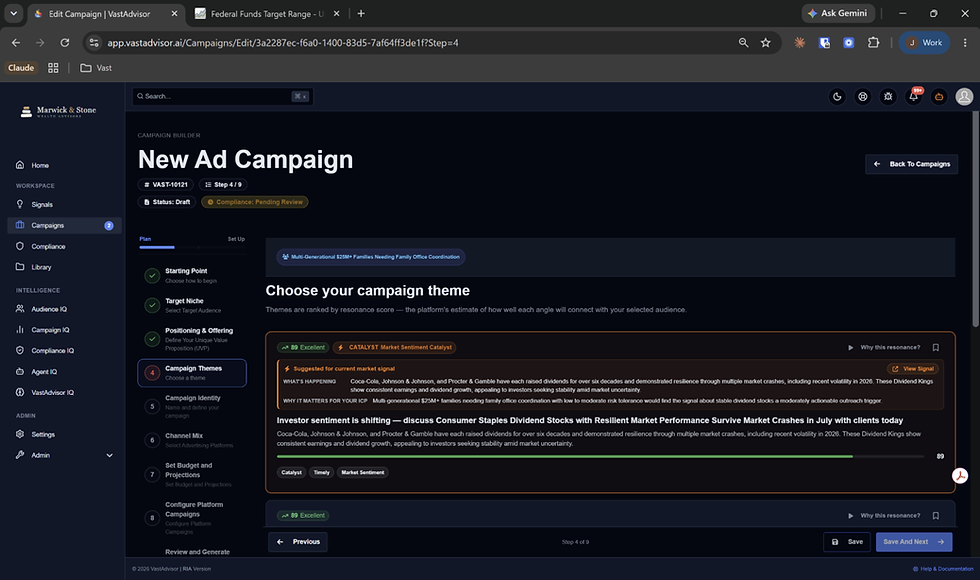
Then it gets personal in the scoring, which is what separates Signals from a news feed. Every firm sees the same CPI print or rate decision; what differs is relevance. When an event arrives, an AI step scores how relevant it is to each of your specific audiences on a 0-to-1 scale and explains why in plain English, so the same rate cut surfaces differently for a pre-retiree book than for a business-owner niche. Edit an audience and the signals re-score automatically, and the page shows only what clears a relevance threshold, so you see why each event matters to your specific clients.
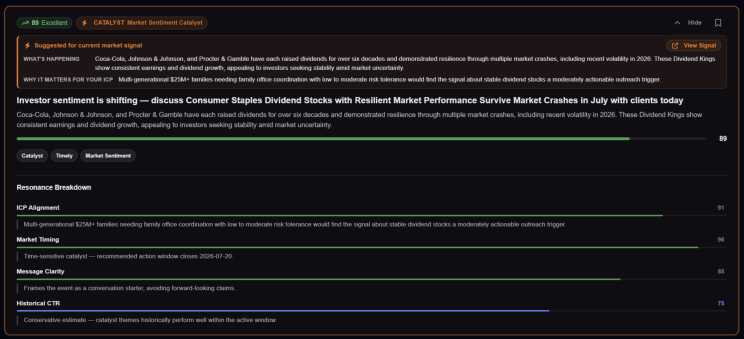
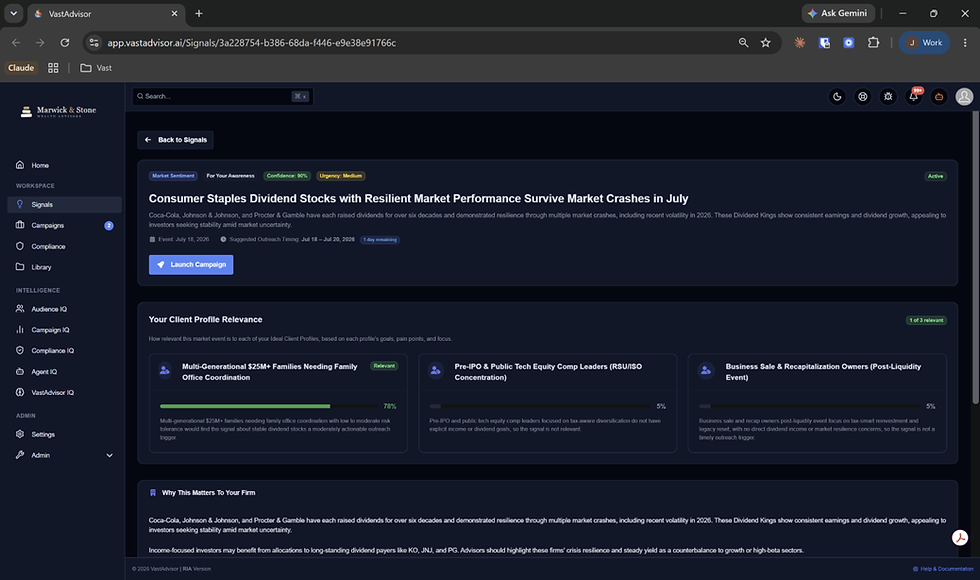
And then it acts. When a fresh, high-relevance signal fits the audience you're building a campaign for, the platform writes a Catalyst theme around it and pins it first, with a note on which signal drove it. A slim banner surfaces the most relevant live signal wherever you are, and one click takes you into the Campaign Builder with the timely theme already written. When timing is on your side, that idea is the first thing you see. When it isn't, the feature says nothing.
Built to Be Defensible
In a regulated industry, a market-timing engine that surfaces the wrong signal at the wrong moment creates real exposure. What an advisor can say to a prospect varies by audience and by event. So provenance is built into the pipeline from the start. Every hard-data signal traces to an authoritative public source (FRED, BLS, BEA, Treasury) with the event, the moment, and the data behind it, and every Catalyst theme carries the ICP context that generated it. For the advisor, that means a compliance reviewer can trace any message back through the theme to the signal and the public source behind it, with a timestamp at each step, so review has a clean audit trail from signal to message. When timing is your value proposition, the credibility of the signal is the whole product.
Where We're Going
What shipped is a radar pointed at the market. The next epic points one at your competitors. Everything Signals does today watches the macro world: rates, inflation, jobs, regulation, regional news. Powerful, but shared, since the Fed cuts rates for everyone. Competitive Signals, the capability we're building in Epic 7, makes the radar personal by treating the specific RIA firms you compete with as their own signal source.
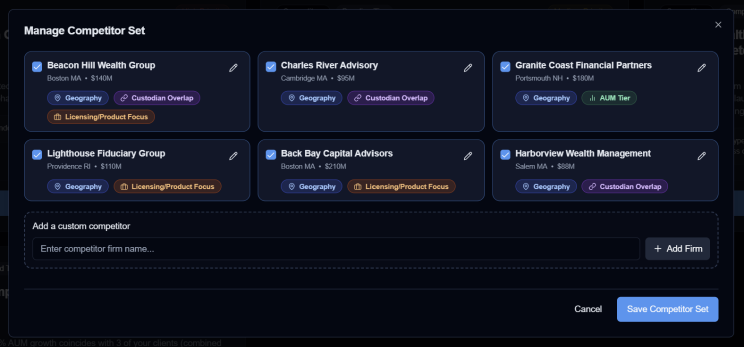
It starts at setup. The platform queries AdvizorPro’s API and surfaces a candidate list of competing firms in your market, inferred from your geography, AUM tier, custodian overlap, and licensing focus; you confirm the list and add anyone we missed. From there, those firms plug straight into the Signals pipeline you already know. Opt into the Competitive category and the platform monitors your named competitors for material moves like an AUM shift, a new Form ADV filing, or a personnel change, then fires a notification within 24 hours, naming the firm, the event, and its magnitude, each with a confidence rating. A new Competitors tab renders each rival as a signal card, with head-to-head comparisons and a competitive-gap summary showing where you're exposed and what to say about it.
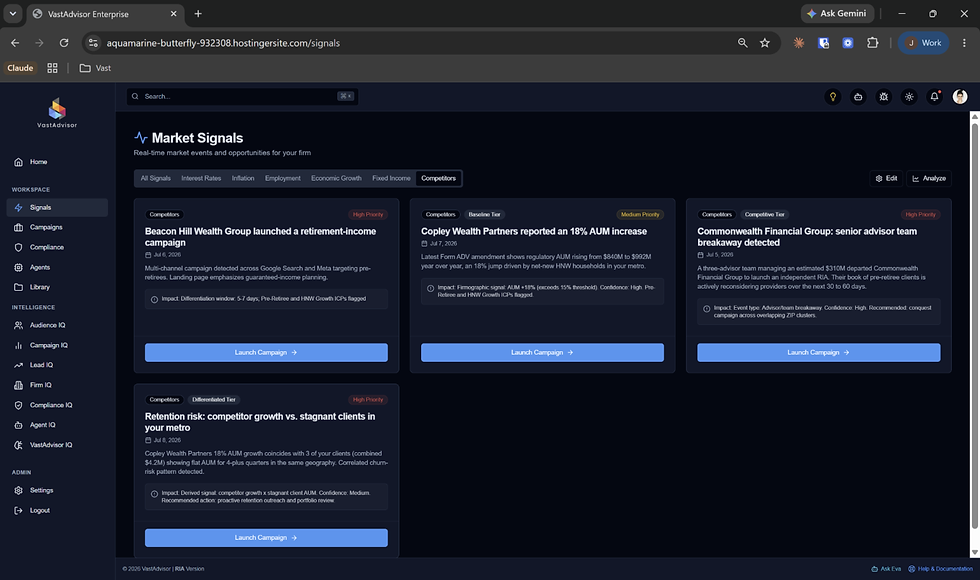
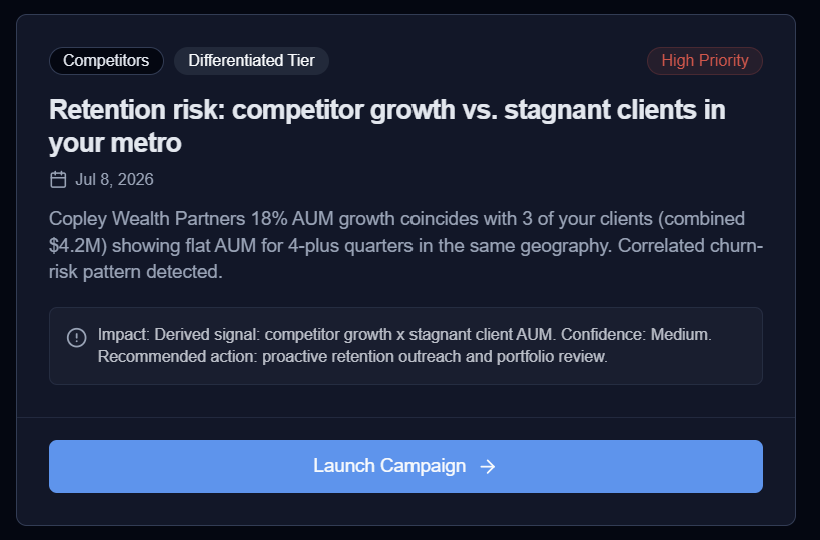
Then it gets genuinely differentiated. Competitor movement gets correlated against your own book: a rival posts a growth event in a geography where your client AUM has gone stagnant, and the platform surfaces a retention alert with a recommended action to protect the relationship before it's at risk. A weekly Competitor Intelligence Digest summarizes the moves that matter across your whole competitive set.
What We've Shipped
Signals didn't arrive as a single launch. We built it across three consecutive sprints, each adding a layer.
v1.12 · Campaign Builder Overhaul & Content Intelligence Foundation (May 2026). This is where the radar was born. Real-time signal feeds went live: continuous ingestion, per-firm fan-out, and the first live surfacing of market events inside the app.
v1.13 · CRM Audit Trail, Smart Signal Filtering & Theme Intelligence (June 2026). The sprint that made Signals personal. Category opt-in shipped, and ICP-aware filtering added a configurable relevance threshold so signals are scored against each advisor's profiles, with plain-English reasoning, before anything surfaces.
v1.20 · CRM Integrations, Memory & Campaign Themes (June 2026). The epic ships. Everything consolidates and goes to production: two signal sources, release-moment activation for scheduled events, real-time push, the live Catalyst banner, and automatic Catalyst theme injection into the Campaign Builder.
Three sprints of groundwork. One capability that turns market timing from a scramble into a system.
VastAdvisor is purpose-built for RIAs and wealth management firms. Our AI platform automates client acquisition from audience definition to compliant, multi-platform campaign execution.
Research cited: InvestmentNews, Ritholtz Wealth Management company profile and Business Wire, Ritholtz succession-plan release (more than $7.6B AUM); Fortune, who won deposits after the SVB collapse and FT via Inquirer, big banks flooded with new clients post-SVB; Think with Google, "Demographics are dead: the age of intent" and Why consumer intent is more powerful than demographics (20% ad-recall lift, 50% brand-awareness lift for intent vs. demographic targeting); WordStream, Quality Score and cost-per-conversion (~22% CPA reduction per Quality Score point, from WordStream's analysis of 15,000+ Google Ads accounts).

Comments